| Status: | Active, open to new members |
| Coordinator: | |
| When: | On Monday afternoons 2:00 PM-4:00 PM First Monday of the month |
| Venue: | Members own home |
We are a small group formed at the inception of the Romiley and District u3a. At first we studied drama, poetry and prose, but more recently have concentrated on prose. Our deliberations have covered a varied range of works: classical and modern; fiction and non-fiction. We usually meet in the co-ordinator's home on the first Monday of the month, although this is sometimes subject to change depending on holidays and other committments. We try to be fairly flexible.
In July we met to discuss ‘ the Long Winter’ by Colm Toibin. This short novella was a little gem. It is set in Spain and focusses on a farming family living in a remote village. The younger son, Jorge is preparing to leave for his military service. Whilst very anxious, he doesn’t talk of his feelings. It becomes apparent that this is true of the whole family, that while there is undoubted affection, each person keeps silent about their concerns. When Miguel, the elder brother learns that his mother is harbouring a big secret of her own, he doesn’t reveal this. Finally, the husband, who has known of her secret all along takes action, with tragic consequences.
The success of the book is the way in which the author intermingles the characters and the landscape, how we are left to discover the dynamics of the family and their relationships with each other and their neighbours as we read.
There are no wasted words. The style of writing is straightforward and skilful. The main theme is one of isolation, that of the characters and their surroundings. We intend to read more work by this author, as we enjoyed the novella so much.
Our next four books are -
August - My Dear, What I Wanted to Tell You - Louisa Young
September - The Housemaid - Freda McFadden
October - Sweet Caress -William Boyd
November - Brooklyn - Colm Toibin
June’s book was ‘Disorientation’ by Elaine Chou. This came with highly recommended reviews, having won a number of literary prizes. We all agreed , however, that it was difficult to get into and what was prized as humour was in many cases farcical. It dealt with a number of controversial issues eg racism, misogyny, academic elitism , fraud and relationships with parents, friends, colleagues etc. We decided that in reality the story was secondary to the views that the author was anxious to air. It was not really enjoyed although we found a lot to discuss.
In May we discussed ‘The Woman’ by Kristen Hannah. The book is set around the Vietnam War and follows Frankie who in a fit of nationalism, and to the horror of her parents, follows her brother to Vietnam as a nursing volunteer. The conditions are terrible at the field hospital where she is stationed, hot, wet , muddy and insect infested. She forms a strong bond with two other nurses who support and advise as she faces challenge after challenge. They become life-long friends. The author’s descriptions are vivid and we all fond the book compulsive reading.
The novel is virtually in two parts. The first part is of the of Frankie’s experiences during the war. The second, and longer part, describes her attempts at rehabilitation in an America that has turned its back on those who fought and doesn’t even recognise the women who were involved. She is vilified and spat at. Her parents pretend that her absence from home was because she was in another part of America. Despite all this and PTSD, Frankie eventually wins through and builds a satisfactory life.
For all who enjoy a good read this book is highly recommended.
In February we met to discuss ‘ The Miniaturist’ by Jessie Burton. This historical novel is set in Amsterdam and vividly captures the sights , sounds and smells of this bustling trading port in the 17th century. The main character Nella moves there after her family had fallen on bad times and married her to a wealthy trader, Johannes, of whom she had little fore knowledge. She expected, however that her life would follow the same path as other women of her standing: dependant entirely on her husband and soon to have his children and to manage the household affairs.
She was met, on her arrival by Marin, Johannes’ sister and his two servants, Otto a freed slave and Cornelia a rescued orphan. She was astonished by the open way in which the servants spoke and soon realised that Marin ruled the household affairs . Johannes was notable by his absence. She soon realised that he was avoiding her and after a while also realised that he was not about to consummate the marriage. In lieu of this he bought her an expensive doll’s house modelled on the house in which she now lived.
She began to receive immaculately fashioned figures recognisable as the family, and their pets. She also kept catching glimpses of a mysterious, fair haired female, who always stayed out of reach. The miniature figures seemed to mirror the events that were to occur. Deep secrets were gradually revealed.
There are a number of plot twists and turns, some unexpected. We thought that the female characters were well drawn on the whole, but the male characters were one dimensional. The book was Jessie Burton’s debut novel. It became an instant best seller, but we decided that there were weaknesses in both the plot and the portrayal of the characters. At times the book verged on melodrama. It was worth reading, but was a little disappointing.
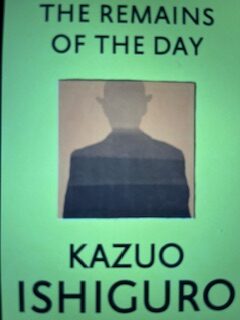
In October we read “ The Remains of the Day’, by Kazuo Ishiguro. This book won the Booker Prize and most of us could see why. Firstly it is beautifully written. It evokes an age of privilege and servitude in the period between the two world wars. It is narrated by Stevens a butler in the service of Lord Darlington whom he revered.
After the lord’s death his next employer, an American, was much more egalitarian and encouraged Stevens to borrow his car, even saying that he would buy the fuel, in order for Stevens to take a holiday. He decided to travel to Cornwall to visit a former employer, Miss Kenton, who had previously worked as housekeeper for Lord Darlington. He hoped that she would return with him and take up her former position.
As he drove south Stevens began to reminisce about his life as a butler, where his sole purpose was to make sure that the lord’s wishes were always impeccably carried out. He prided himself on his loyalty and efficiency and reflected upon what it meant to be a ‘great’ butler. As he travelled he became aware that the world was changing as he met various people and viewed the interaction between them. He determined that he must learn how to ‘banter’.
Ishiguro shows us a character that slowly begins to realise what he had sacrificed in order to be a ‘great’ butler. All his life he had subjugated his own thoughts and feelings in favour of Lord Darlington, whom he believed could do no wrong. After his death Darlington is pilloried as a Nazi sympathiser.
We had a good discussion about the book , reflecting on the expertise of the author and the character of Stevens, Miss Kenton and Stevens’s two employers. We also considered how times had changed and considered what it meant to be British according to Stevens.
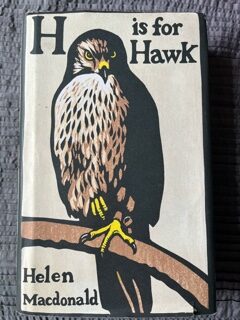
In September we met to discuss “H is for Hawk’, by Helen Macdonald.
This an autobiographical account of Helen’s struggle to come to terms with the sudden death of her father. Helen was a lecturer at a Cambridge College, an author, illustrator, poet and falconer. She purchased a goshawk, after persuading the seller that the one ear-marked for her was not suitable, as she had an immediate affinity to the smaller bird.
Goshawks are notoriously difficult to train, and Helen had many ups and downs in the process. She named the hawk Mable, meaning beautiful, and Mable’s personality soon revealed itself.
Helen withdrew herself from human contact and devoted herself solely to Mable to an unhealthy degree and began to take on Mable’s characteristics. She wasn’t really dealing with her grief.
As Helen recounted her own story she also deviated to include a biography of T. H. White of ‘Sword in the Stone’ fame. He also had trained a goshawk by methods more to do with power than kindness, knowing no better, and being influenced by the way he was ill-treated in his youth. He was also struggling with his sexuality at a time when homosexuality was illegal.
The book was not well received by the group despite the acknowledgement of the vivid descriptions and the remarkable bond achieved between human and bird. The discussion circled around whether it was cruel and wrong to keep a bird in captivity and Helen’s mental health. Most also found some of the details of the hawk’s diet ghastly and repetitive. Well one wins some and loses some. Not everyone has the same opinions. It is good to have varied opinions and to be able to express these.
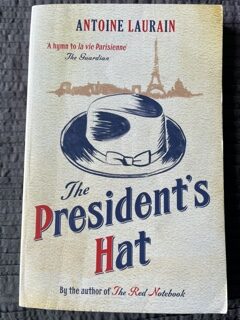
In August we read ‘the President’s Hat’ by Antoine Lorain.
This was more of a novella, being short, but it was perfectly formed and very enjoyable. Everyone liked this book.
It began when a young man treated himself to dinner in an expensive restaurant whilst his wife was away. To his joy, sitting at a nearby table was President Mitterrand, who inadvertently left his hat behind when he left. The young man, who could have called after him, stole it.
The next day he wore that hat to work, and felt empowered by it. In a meeting with the managing director, to the astonishment of those present, he spoke up lucidly and intelligently about the accounts. This led to a complete change in his life.
As his journey started, so did the hats. He carelessly left it on a train and it was picked up by a young woman on her way to an illicit meeting with a married man. Her life changed also from this point.
And so the hat’s journey continued as it was found by others and affected their lives in various ways, until eventually it found itself back to the president.
We had an interesting and lively discussion about this story, reflecting on the lives of the various characters and how ‘lucky’ objects can have a psychological effect on people. We have no hesitation in recommending the book.
In July we met to discuss ‘Sheltering Rain’ by JoJo Moyes.
This was the author’s debut novel and she has gone on to write much more. We agreed that this was an easy read, a holiday novel, quite a change from June’s book.
The story was character driven and explored the relationships between four generations of the same family. Set in Hong Kong initially the story moved to Ireland, The two countries were vividly depicted. The characters were well-rounded and the misunderstandings, secrets and affection were realistically portrayed.
We discussed the reasons behind the characters thoughts and actions and how their differences were finally resolved. We also agreed that there were some weaknesses in the plot and that JoJo Moyes had written better novels but on the whole the book was well received.
We met in June to discuss ‘Demon Copperhead’ by Barbara Kingsolver after a break due to illness.
This book won a Pulitzer prize for fiction. It is a challenging read, at times quite depressing, but comes eventually to a satisfactory conclusion.
Demon is in fact Damon, but was given his nickname due to his red hair. The story follows his life from the only child of a drug addicted mother and the physical and emotional abuse from his mother’s husband, until her death from an overdose.
From this time he was in the hands of the American social services and was fostered by three different people. He as a virtual slave to the first, starved by the second and finally, after intervention by his estranged grandmother, sent to live with Coach where he was trained to be a star in the college American football team. Things went well until he sustained a knee injury.
The story is punctuated by the friends he made and by those who led him astray. Throughout he doesn’t bemoan his fate and accepts stoically whatever is thrown at him, although he feels a lot of anger He is the narrator of his own story and as such it was important the reader was able to like and admire him.
We decided that this was an important book. It raised many important questions and highlighted the failure of social care in the rural parts of America.. Our discussion was wide ranging and related in many ways to the problems faced in this country as well as in America
In April, we abandoned books for a while and met to celebrate our postponed Christmas get together for meal at ‘The Little Mill’ Rowarth, where we enjoyed a lovely meal and a good chat. We are never short of words!
In March we discussed ‘The Love Song of Miss Queenie Hennessy’ by Rachel Joyce.
This is a companion book to ‘The Unlikely Pilgrimage of Harold Fry’, which we had read previously. When Queenie is dying of cancer she writes a letter to Harold that starts him on his journey. Meanwhile Queenie relives details from her past, her relationships and feeling and her connection to Harold’s son David and her meeting with his wife. We learn about the other patients and staff in the hospice and their resilience and the way they find joy in the face of death. As Queenie confronts her own feelings she is able to find peace before she dies.
We did not enjoy this book as much as the first one and wondered why the author decided to give Queenie such a terrible form of cancer one that made her helpless and mute – possibly so that she could relive everything in her mind?
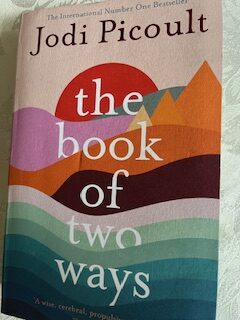
On 3rd February we met to discuss "The Book of two Ways" by Jodi Picoult.
‘The Book of Two Ways’, by Jodi Picoult, our February book, is quite a challenging read. The main character, Dawn, trained as an Egyptologist, a profession she loved. When her mother got ill with cancer she abandoned her doctorate and her work in Egypt to care for her. Her mother died and she married Brian and had a child, Meret, and began working as a doula caring for the non-medical needs of the dying.
However, things became confused when she was in a plane crash and remembered her fascination with Egypt and her former lover Wyatt. She returned to Egypt and became immersed again in its archaeology, reuniting with Wyatt and torn between her life there and her life in England.
The story is built around tales of Egypt, the discovery of its artifacts and Egyptian beliefs and Dawn’s life as a doula. Throughout It switched in time and location. Surprising facts are revealed and Dawn has important decisions to make.
Whilst not always an easy read, it was quite fascinating and engendered a lively discussion.
In January we met to discuss The Second Sleep by Robert Harris
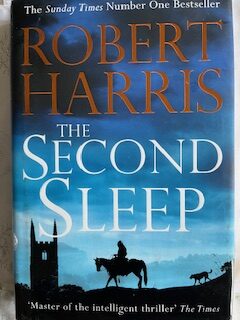
The book opens in 1468, but is confusing as plastic is mentioned and the King James Bible. It soon becomes clear. An apocalypse has occurred and time restarted. (Later in the book various reasons of why this had occurred were suggested). Sadly, things seem to be progressing similarly to what had occurred in the time before.
The Church was in charge and had a strangle hold on the populace and any questions or inquiries were treated as heresy. The population of England had shrunk from 60 million to 6 million, technological, medical and social advancements had disappeared, and books were burnt. Women sat outside their doors spinning, public hangings were held and life was hard.
Into this world a young priest was sent to conduct a funeral in a remote village He came across some ledgers and artifacts that caused him to examine his former beliefs. His disquiet was confounded when a landside prevented him from leaving and returning to the seminary where he had become indoctrinated. He rapidly became very conflicted and found himself deviating from his former beliefs.
The story follows the quest for answers and to say more would have too many spoilers for those who wish to read the book.
In our discussion we soon began to draw parallels with the world of Trump, Musk, Putin and the like; disinformation and propaganda on social media; the dangers of believing too easily what we are told; and the various problems and conflicts around the world.
Harris had written a book which could be read on different levels and had given a warning – are we asleep to what is happening in our world? Will our complacency lead to the destruction of the world as we know it?
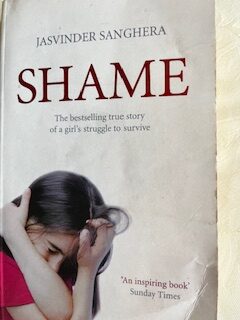
In November we met to discuss ‘Shame’ by Jasvinder Sanghera.
This is an account of Jasvinder’s life. At 15 years of age she was shown a picture of the man she was to marry as arranged by her Sikh parents. Jas was appalled, she wanted to go to college and lead her a different life. In the end unable to convince her parents that she didn’t want the life that was expected of her, she ran away with the brother of a friend. He was of a lower caste than herself.. In taking this action , in the eyes of her her family and the Sikh community, she was shamed. As a result she was pronounced dead by her mother and doomed to be ostracised by her sisters This caused her great distress. In her search for affection, acceptance and reconciliation she faced many different problems and anxieties.
As we follow her struggles in the book, it becomes a compulsive read, and we should like to recommend it, even though you will be as appalled, as we were, as cultural differences are revealed, and be sickened by what Jas and others like her in some families had , and maybe still have, to endure.
In October we met to discuss ‘The Marriage Portrait’ by Maggie O’Farrell.
This book was inspired by ‘My Last Duchess’, a poem by Robert Browning. It follows the life of Lucrezia , a spirited, intelligent and artistically talented 15 year old. She was the youngest daughter of the Grand Duke, Cosmo de Medici, of Tuscany. As such she led a sheltered life in which she was kept safe in her family’s castle. That is until she was married to Alfonso Duke of Ferrera after his betrothal to her sister Maria was ended by Maria’s death. At the beginning of the book Lucrezia states that her husband is planning to kill her. We have to decide if this is an hysterical claim by an over-wrought girl or, in fact, is true.
The story is vividly depicted as we learn of the clothes, meals, houses, weather and not least of the manners and privilege of the wealthy and the ordinary people of the !6th century in which the story is set. We follow Lucrezia from her family home to a country dwelling of her husband, to the magnificent palace, and a hunting lodge. There are many characters in the story that we learn about through our heroine and her relationships. It soon becomes apparent that the Duke wields tremendous power – his word is law, but is he planning murder? We recommend that you read this book to find out, and hope that you enjoy it as much as we did.