Our monthly meetings are held on the fourth Thursday of the month, starting at 2.00 pm, in the Romiley Methodist Church. They are open to all members. An admission charge of £2 per person is made to cover the cost of hiring the room, paying the speakers fee and providing refreshments.
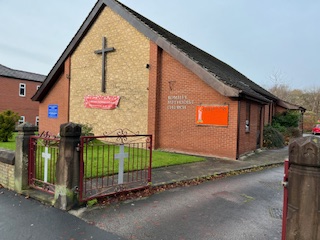
Romiley Methodist Church
77, Stockport Road
SK6 3AA
OS Ref map 109/939908
On Thursday 26th March David Poppitt (Retired Oncologist) gave a talk about the 'History of the Christie Hospital' He first went to the Christie as a medical student in 1966 and worked there for many years specialising in experimental chemotherapy initially and then developing an interest in cancer education which led to the establishment of the Christie Charity, The Christie is the biggest single site in Europe for the study and treatment of all types of cancer and clinical oncology. The disease is very ancient as discovered from archaeological records, but it was during the industrial revolution that large numbers of testicular cancer were recorded in chimney sweeps and mill workers, who were exposed to toxic substances in their daily work. This started off research in the 1880 ’s and 1890’s and in Manchester four prominent local businessmen and philanthropists Joseph Whitworth, Edward Holt, John Ryland and his wife Anne and Richard Christie and his wife and these set up a unit near to where the M.R.I. is situated now. The unit was called “Institute for Incurables”. In those days it was considered a place where you would go to die, whereas now it is a place for hope and the best possible treatment. Edward Holt became interested in the work of Marie Curie about radiation, and this led to the hospital changing its name to the Holt Radium Institute and finally “The Christie”. It has grown from 300 staff in 1966 to 5000 now with treatment hubs throughout the country so that patients can be treated nearer to their home. David explained about the work that is carried out today clinical trials and research which surprisingly is not funded by the NHS. He became Appeals Director, responsible for raising awareness and charitable donations to fund this work. He has been involved in many schemes, most notably tapathons with the support of Roy Castle, Norman Wisdom and Les Dawson. It was a most enjoyable and informative talk and £97 was donated by the members to the ongoing research of the Christie hospital after the talk.
At our February meeting we were entertained by Joy and Kevin Sidall with their hand-picked selection of songs with stories entitled ‘Lyrical Allsorts’. Their act featured songs from over 100 years of great music and genres including pop, jazz and musical theatre. The songs were accompanied by high quality backing tracks, acoustic guitar and even a ukulele and included the theme song from “Georgie Girl” , “Both Sides Now” by Joni Mitchell, and Bob Dylan’s “to Make You Feel My Love” and many others. Each song was accompanied by a story either about the origin of the song, or the singer or songwriter. “Mack the Knife” was sung in German and “La Vie En Rose” by Edith Piaff was sung in French. Many of the songs were old favourites which had the audience clapping or foot tapping, a very enjoyable performance.
In September we enjoyed a talk entitled ‘My life messing about with drawing and painting’, by Dave Lee.
Dave began by taking us through his early life. At school he was offered an alternative choice of Woodwork or Latin. He opted for woodwork, but was forced into Latin, which he soon dropped. Dave explained how he had always been fascinated by machinery and construction. He won prizes for his woodwork, but soon began to ‘mess around’ with drawing and painting. For many years he taught art and also, when in a weak moment, he mentioned that he played the piano, played in assembly and was involved in many school musical shows.
Dave is a man of many talents.
When he stopped teaching he devoted himself to his art, amassing a huge collection of work. He brought along a large selection of this for us to look at. It consisted of sketches, pencil and ink drawings and paintings using various mediums. The subjects ranged from portraiture, landscapes and detailed pictures of industrial construction . He admitted to being fascinated by rocks. One large painting , half-finished was shown and he invited us to explain what was still needed =-the answer was movement.
Dave was scathing about those who produced so-called art in a matter of minutes and charged vastly inflated prices. His own work could take up to many weeks. He insisted that he was not interested in selling any of his work at the meeting, but invited those who wished to visit his studio.
In August we held our Summer Social in the Romiley Methodist Church meeting hall.
We had cake, biscuits, tea and coffee. To exercise our minds we had a quiz with prizes.
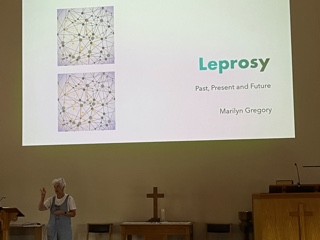
In July we were treated to a talk from Marilyn Gregory entitled ‘Leprosy, Past, Present and Future’ – as she freely admitted not something that sounded immediately appealing!
However, this turned out to be an entertaining and informative talk. Marilyn had worked for the Leprosy Mission and was able to speak knowledgably and fluently and used illustrations to underline her subject.
Leprosy is an illness feared by many and the term leper in common parlance to many means something to be shunned, and those with leprosy throughout the ages have been ostracised and deprived of social contact. Victoria Heslop’s book ‘ The Island’ vividly depicts this.
In medieval times those with leprosy were given death rites by the church and sent away.
In the UK there are still 30 cases of leprosy each year, although all can be traced to those who have lived abroad. World wide there are 158,000 diagnosed with leprosy of which 53% are in India. It is also present in Nepal, Brazil, Tanganyika, and Florida. It thrives in areas of deprivation with overcrowding, poor nutrition and hygiene and is on the increase especially in children.
Leprosy is not spread by touch. The virus is inhaled and even then a person has to be in close contact with a person with leprosy for a considerable time before it is possible to contact the disease. 95% of the world’s population is immune.
The first symptom of leprosy is when white, numb patches appear on the skin. It attacks the bones and nerves in the hands, face and feet, leading for a foreshortening of the bones and a lack of sensation in the affected areas. This gives the ‘club’ hands and feet of the infected person and the lack of feeling , in turn, leads to many horrendous injuries.
The disease effects people in all ways, physically, emotionally and socially. Up to two years ago a person with leprosy could be divorced for that reason.
There are treatments for leprosy. An operation to strengthen tendons can lead to more control. Special shoes are made from car tires, and made-to -measure prosthetic limbs.
Leprosy is curable. The first effective treatment was found in the 1950’s, but some resistance developed a few years later causing the leprosy to re-occur. Now two other drugs in combination provide a cure after six – twelve months. Leprosy is no longer fatal but reduces the life expectancy of those infected and can be fatal if chickenpox is encountered.
There are instances of suicide because of the stigma of the disease.
The Leprosy Mission was started 150 years ago and helps communities to develop cottage industries to sustain themselves. There is a hospital research facility dedicated to finding a vaccine. This is difficult in the laboratory as only the red squirrel and the seven banded armadillo can be used to assist the process.
Marilyn treated us also to many interesting anecdotal stories of her time in Africa with the mission.
In conclusion those with leprosy are no longer to be feared and deserve our compassion and help.
On Thursday 26th June Roger Browne gave a very entertaining talk about the era mainly in the 50’s before television, when the radio was used to inform, educate and entertain the population. He played the keyboard to remind us of the theme tunes from programmes like ‘music while you work’,’ family favourites’ and ‘workers playtime’, which were designed to raise the spirits of people after the war. The talk covered comedy programmes such as ‘itmar’ and ‘round the horn’, information such as ‘letter from america’ by Alistair Cook, science fiction and children’s tv. The talk was full of interesting anecdotes and music, including ‘Miss Otis Regrets’ by Cole Porter- an excellent rendition, and a performance of the ‘20th Street Rag’, played at a very fast pace. He concluded a very enjoyable talk with a medley from popular musicals.
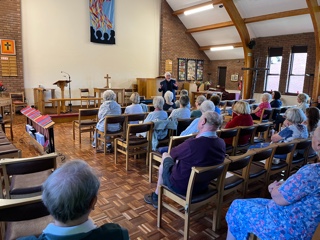
The Speaker on 22nd May was Frank Rothwell who holds 4 Guinness book of records for sailing and rowing.
He made a fortune from manufacturing and renting out portacabins fitted out as accommodation pods, which enabled him with his family to enjoy sailing first around Ireland , then Europe. He them became more ambitious and sailed with a voluntary crew around North America, which entailed sailing through the north west passage a very hazardous experience. His next venture was to sail around South America, this time with a paid crew, the combination of both North and South America in a figure of 8 eventually earned him his first entry in the Guinness Book of World Records

He then became interested in rowing and sailed solo twice from La Gomera in the Canary Islands to Antigua in the Caribbean, at the age of 71 & 73, for which he earned a further two GBRs. The talk illustrated the difficulties of rowing single handed both physical and mental, plus of course adverse weather conditions especially for someone in their seventies, it was a remarkable achievement and a very interesting talk, followed by questions.

On Thursday 27th march Pete Mellor delivered a very interesting talk about the assassination of JFK on 22nd October 1963.
He explained that the President has travelled with his wife Jackie and the Vice President LBJ to Dallas Texas, as part of his re-election campaign. The talk examined the route of the cavalcade with security motorbykes through Dallas, and the theories regarding the assassination which contradicted the official version that Lee Harvey Oswald, acting alone had fired the fatal shots from the school book depository, and was subsequently shot by Jack Ruby. The talk was very well illustrated with photographs, demonstrating the possible ways in which other possible assassins could have fired the shots from different locations along the route. A very informative talk by a man who knows his subject thoroughly.
On Thursday 27th February Paul Girt gave a talk about "Gardening indoors and outside"
Paul had brought with him several varieties of potted plants. These became an aide during the first part of his talk which was -Gardening Indoors. He talked about ways to tell if a plant needed water or not, by lifting the pot to see if it was heavy and therefore not in need. He recommended standing the pot in water to let water soak up rather than pouring in from the top. Demisting leaves with a spray was also a valuable way to get rid of dust and allow plants to breathe. He showed how to remove plants from their packaging by squeezing the sides rather than tugging them out. To tell if a plant was root bound, push a finger round the rim. Only repot to the next size up plant pot. He told which house plants liked which temperature environment and had a lot further tips to keep them healthy.
The next part of his talk was –Gardening outdoors. He talked about bedding plants and said many come from abroad and need to be hardened off by putting them indoors overnight. He recommended not digging them in till May when the ground has warmed up. To tell if they have come from abroad there will be labels showing EC as their passport numbers. He gave tips re how to plant up hanging baskets, troughs etc. He enthusiastically described treatments for pests, trimming back roses and shrubs, tree planting and all other aspects of gardening. He had gardening magazines to give away and the demo plants could be bought for very little cost. He encouraged members to come up and ask their questions after the meeting.
He was given a hearty round of applause!
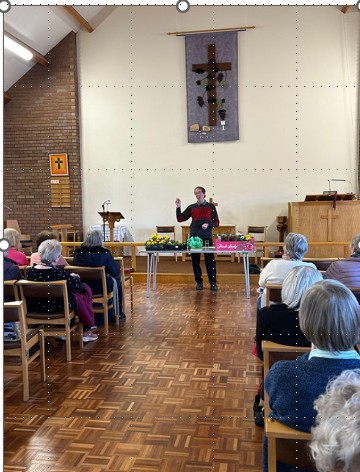
On Thursday 23rd January we had a talk by Bob from the Danny Steamship Company about the Manchester Ship Canal.
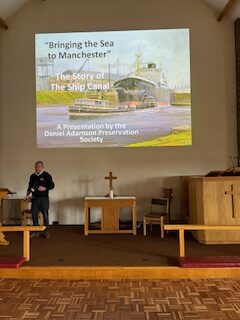
Bob gave a fast moving talk about the origins and history of the canal. The slides and film clips really held our attention. He explained that the canal was made in order to increase trade between Liverpool and Manchester ports. The canal generally follows the original routes of the rivers Mersey and Irwell. When the Ship Canal Act was passed Lord Egerton cut the first sod. 16,000 men with simple tools and mechanical ones such as steam excavators, dredged and shaped the route. Soon money had run out and Manchester Corporation stepped in with funding. Instead of being known as Salford Docks, Manchester claimed the title of Manchester docks. The canal opened for use on 7th December 1893.
There have been stages of busy use and lesser use, but nowadays it is thriving with companies such as Petro Chemicals, using the canal for transportation. Salt, Soda Ash, Scrap Metal, Grains, Heavy Lifting Equipment are other users.
On 12th December we held our Christmas celebration.
We had food to feed our bodies and quizzes to exercise our minds.


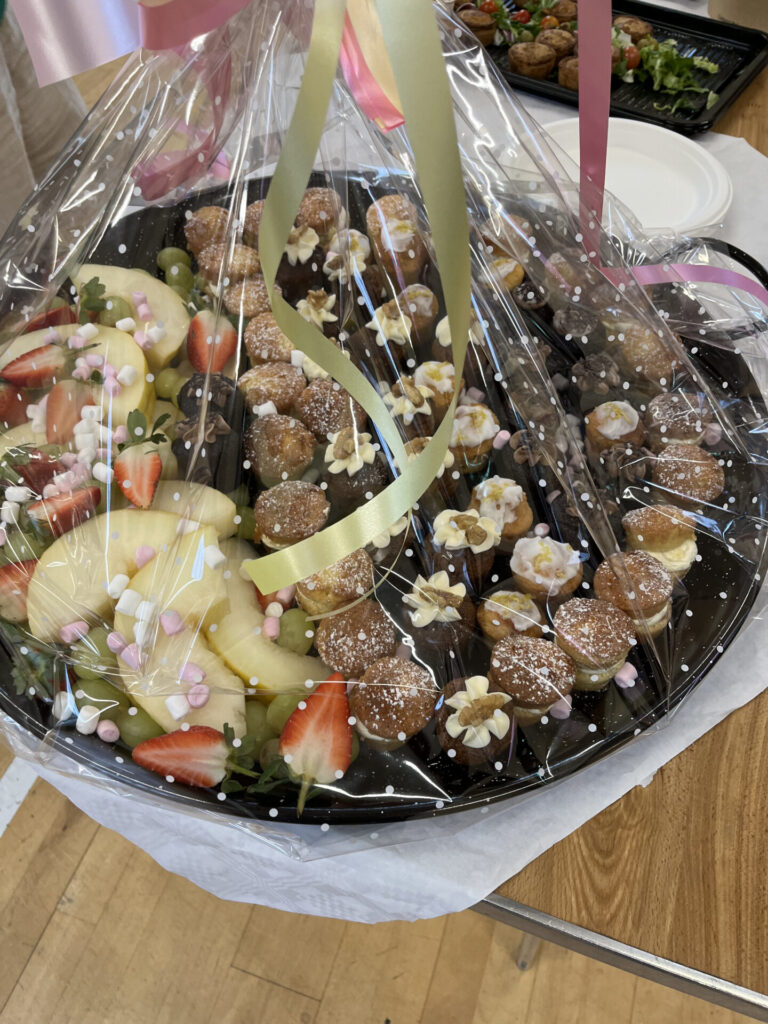

There was a food hamper as a raffle prize and boxes of chocolates as lucky ticket prizes.
On Thursday 28th November Mark Llewellin gave us a talk on Coronation Street.
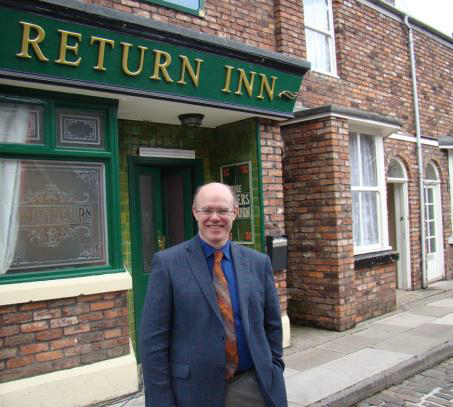
Mark Llewellin on the set of Coronation Street and talking to us about Coronation Street
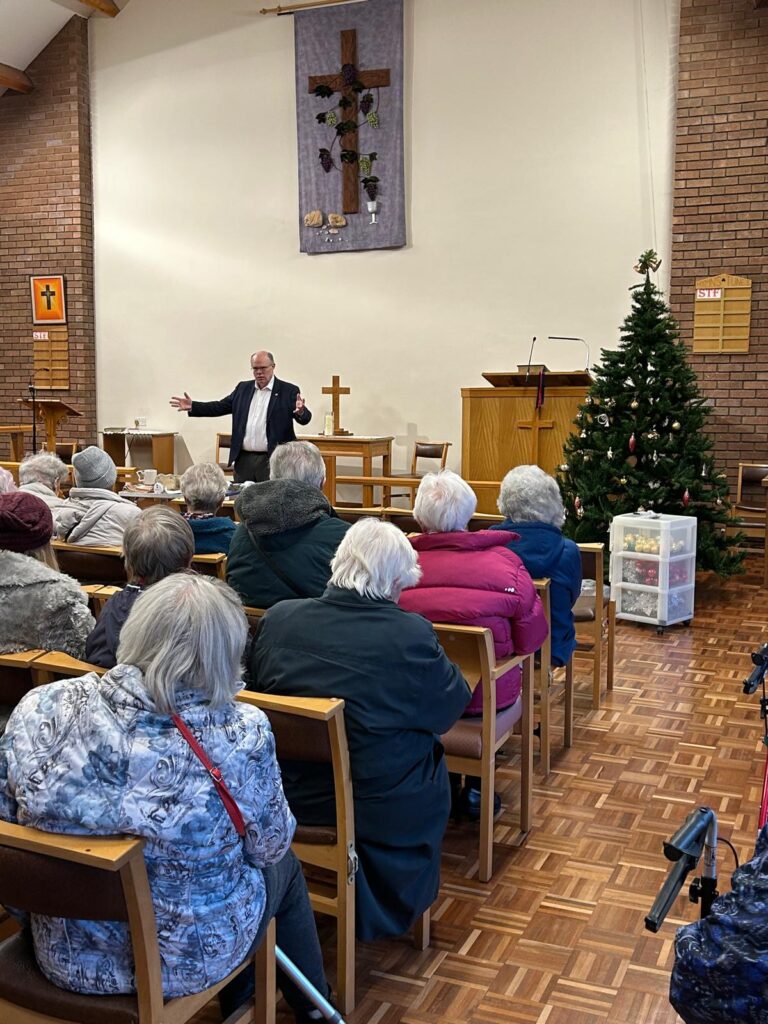
His online site highlights many other accolades and he is well known in the entertainment industry. He is Deputy Lieutenant of Greater Manchester, a trained actor, former director of marketing at the Oldham Coliseum Theatre, has written four books, has written over 12 pantomimes etc, etc.
He has lectured on the history of Coronation Street for many years.
He explained it is shown in 40 over seas countries and he looks after the fan clubs for these. In America it was sponsored by Soap Companies – hence we know it as a “Soap”. It is the longest running TV drama and has shown 11,000 episodes. It was managed by Granada Television but is now under ITV.
He spoke with humour and told us how it came to be. The Bernstein brothers used a map of Britain’s rainfall to select Manchester as a profitable area to use. Their logic was that due to frequent wet evenings viewers would tune in to the program more often than viewers in drier areas. So on 3rd May 1956 the show opened. At the time there were soldiers returning from the Boer War and they were called Rovers. The pub became “The Rovers Return. “Lancashire blues” is the name of the show’s iconic music.
280 people work on the show. It is now 64 years old. There have been 107 weddings, 51 births and 237 deaths.
Mark held our attention for even those who don’t watch the show and brought many a giggle
By Anne